Portrait of Amrapalli Garanaik

Amrapalli Garanaik, Ph.D.

Assistant Professor (Senior Research) · Physical Oceanographer · Fluid Dynamicist
College of Earth, Ocean, and Atmospheric Sciences · Oregon State University

My research seeks to understand how turbulence and multiscale interactions govern the transport of momentum, heat, and tracers in geophysical and environmental flows, and how these processes shape the evolution of the ocean and climate system. By combining fundamental fluid mechanics, theory, high-resolution simulations from process scales to Earth system modeling, observations, and physics-informed machine learning, I bridge the gap between small-scale turbulence physics and large-scale Earth system prediction. A central goal of my work is to translate physical understanding into robust, physics-based parameterizations for next-generation ocean and climate models.

What I work on

Research

Using numerical simulations, laboratory experiments and observations, I tackle challenges in our Earth system through fluid mechanics. Here are the main themes of my research.

Upper-ocean mixing parameterization

Schematic of local and non-local transport in the ocean surface boundary layer

We developed a new physically based vertical mixing scheme for the ocean surface boundary layer (OSBL): a plume-based hybrid mass-flux and high-order turbulence closure. The new scheme effectively captures non-local mixing under different forcing regimes.
Surface waves and Langmuir turbulence

x–y cross sections near the surface (1 m depth)

We study different upper-ocean mixing regimes, including convective, shear and Langmuir turbulence, using GPU-accelerated large eddy simulations and observational data, and use what we learn to improve how these non-local mixing processes are represented in models.

Lagrangian particle tracking

Plot by a 2025 NSF REU student.

GPU-enabled Lagrangian particle tracking inside high-resolution LES, used to follow how Langmuir turbulence and convection transport, disperse and mix water parcels, including non-local transport.

Diurnal warm layers

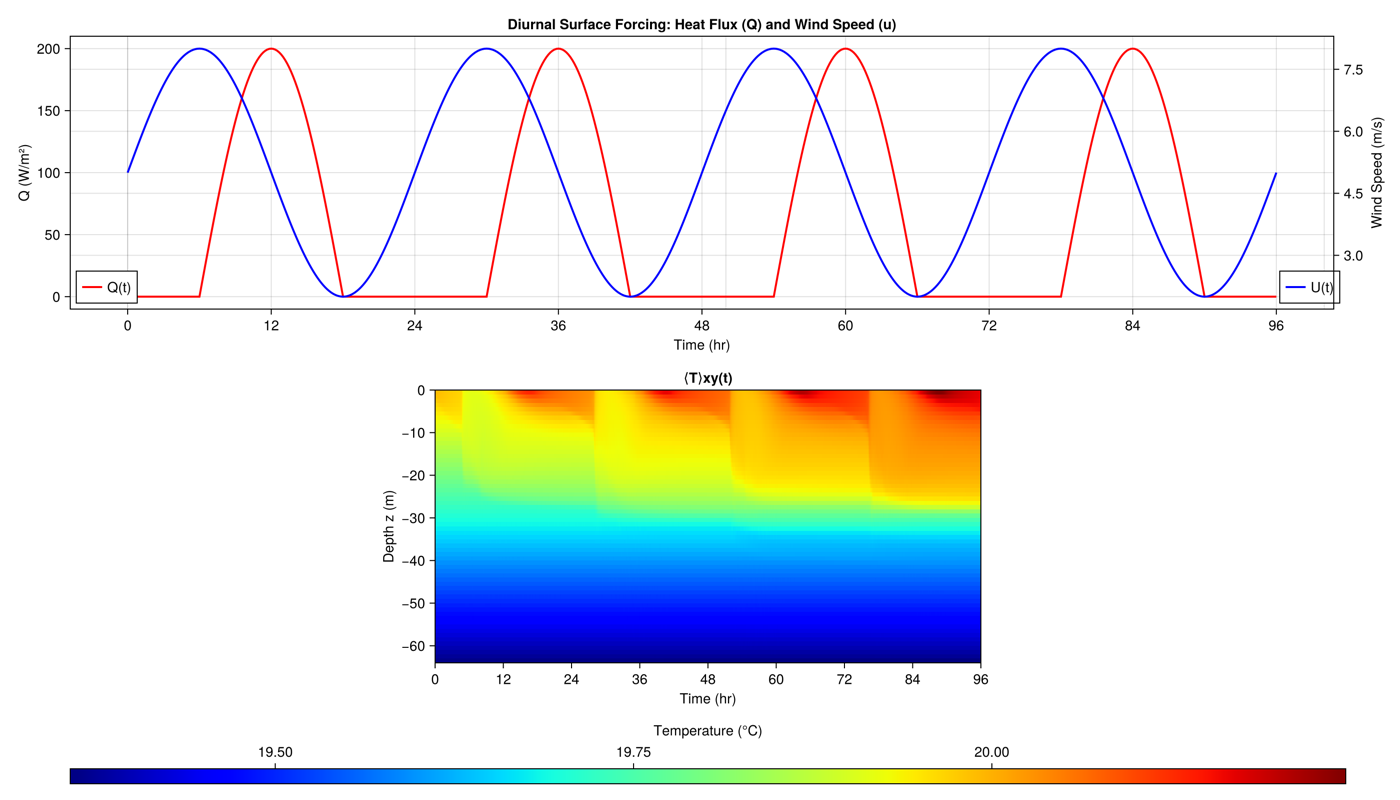
LES of four diurnal cycles: surface heat flux and wind speed forcing (top) and horizontally averaged temperature versus depth and time (bottom), showing a warm layer forming each afternoon

Plot by a 2025 NSF REU student.

How daytime solar heating, variable winds and surface waves interact to form and break down diurnal warm layers, and what that means for upper-ocean turbulence and mixing.

Stratified turbulence and diapycnal mixing

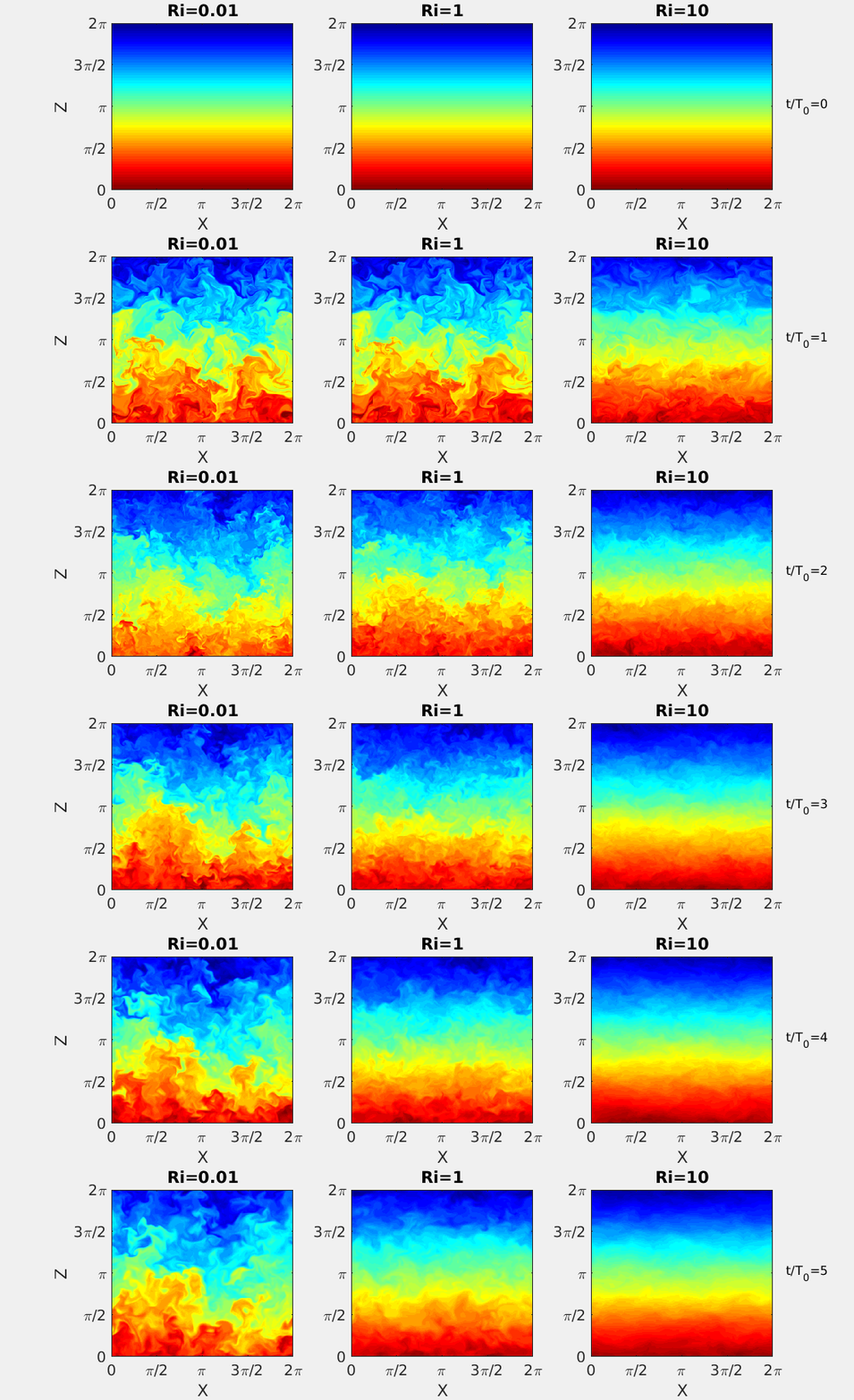
Animated density field from DNS of stratified turbulence at Ri = 0.01, 1 and 10

Direct numerical simulation (DNS) and theory that show how stable stratification controls turbulence, mixing efficiency and diapycnal diffusivity, and how mixing can be inferred from quantities measured in the field.

Earth system modeling

Implementing and testing new ocean physics in the DOE's Energy Exascale Earth System Model (E3SM) and its ocean component, MPAS-Ocean, to reduce biases in climate simulations.

Mesoscale mixing

Lagrangian particles tracking eddies in a global ocean model

Online Lagrangian particles (the LIGHT package) in eddy-resolving MPAS-Ocean, used to quantify spatial and temporal variability of isopycnal diffusivity at LANL.

Air–sea interaction: satellite and in situ data

Research vessel at seaNASA S-MODE logo

How SST, surface currents, diurnal warm layers and waves shape the exchange of heat and momentum between ocean and atmosphere. This work uses Saildrone data from NASA's S-MODE, observations from Buzzards Bay, and tropical coupled modeling. I also did fieldwork on the ASIRI cruise in the Bay of Bengal.

GPU computing

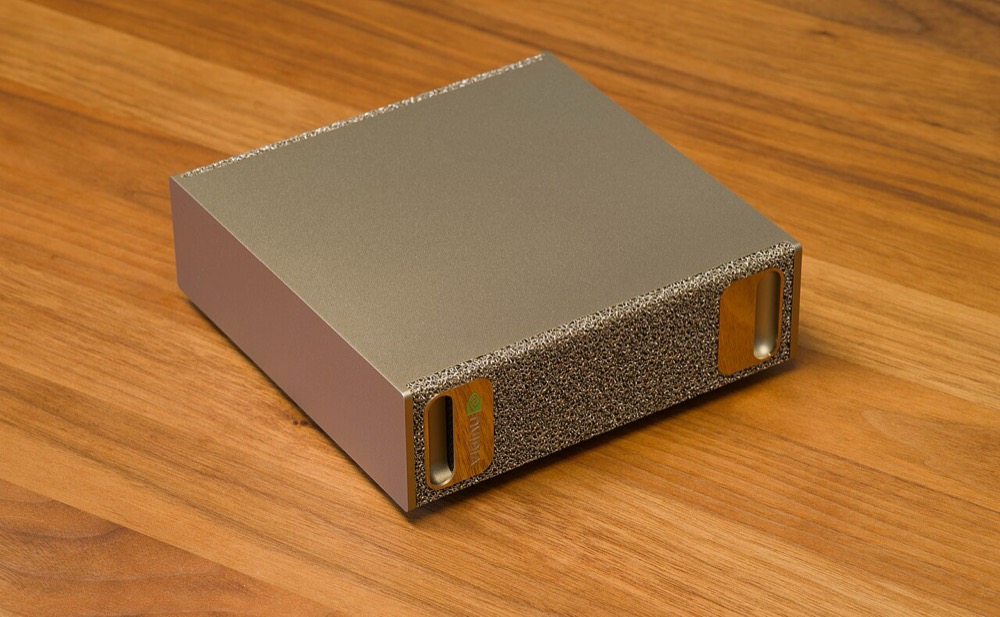
An NVIDIA DGX computerBenchmark: normalized wall time versus number of grid points for single- and multi-thread CPU and V100/A100 GPU runs

Our lab has an NVIDIA DGX system for GPU-accelerated ocean simulations. We run LES with Oceananigans.jl on DGX, A100, V100 and H100 GPUs and on Grace Hopper systems at OSU. The benchmark (right) compares wall time on CPUs and GPUs as the grid grows.

Representative photo: NVIDIA DGX Spark, by Daniel Lu, CC BY-SA 4.0.

Ice–ocean interaction

Simulations of internal waves generated by glacier calving and subglacial discharge, and their effect on submarine melting at Greenland's marine-terminating glaciers.

Physics-informed AI

Combining physics-informed machine learning and data-driven analysis to improve parameterizations of high-order turbulent fluxes in ocean and Earth system models.

Team

People

Current team

  • Amrapalli Garanaik
    Amrapalli GaranaikPrincipal Investigator · Advisor
  • AF
    Alyda FaugnoPh.D. student · Sep 2026–present
    Co-advising with Roger Samelson

Currently serving on thesis committees

  • VH
    Vanessa HawkinsPh.D. student · Oregon State University · Committee member, 2025–present
  • AA
    Athena AnsyahPh.D. student · Oregon State University · Committee member, 2025–present

Past students

Collaborators

Los Alamos National Laboratory

Applied Physics Laboratory, University of Washington

Missouri S&T (formerly Colorado State University)

Akvaplan-niva, Norway

HKUST (Guangzhou)

University of Delaware

University of North Carolina at Chapel Hill